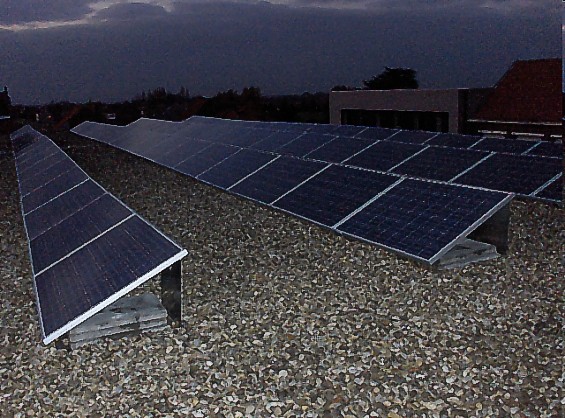
Due to their favourable orientation towards the sun and the availability of unused space, an increasing number of photovoltaic systems are being installed on the roofs of buildings and industrial halls. The mounting of roof-mounted systems is of particular importance, as these fastening systems must be as lightweight, simple, and quick to install as possible. Conversely, the mountings must also be capable of withstanding the most severe hurricanes. To find an optimal constructive compromise for the fastening system, precise knowledge of the wind loads acting on the PV panels is essential.
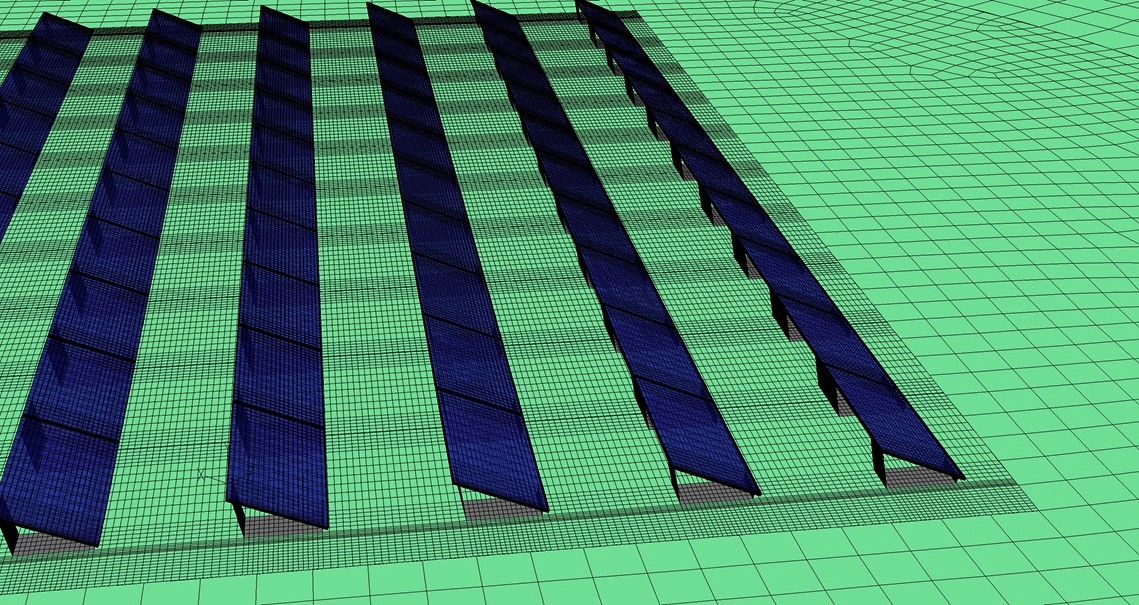
For this reason, FlowMotion was engaged as a specialist in all aerodynamic matters to determine these loads. Since wind tunnel tests usually only allow for the determination of an integrated total force per PV panel within a system, computational fluid dynamics (CFD) simulations were employed in this project. These allow for a much higher information density regarding the force distribution and direction along each individual PV panel.
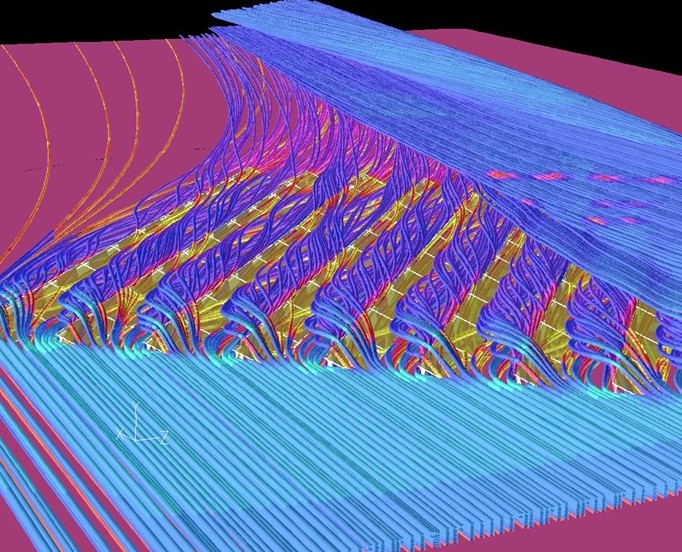
It became evident that for the various simulated wind directions, the load distribution for each PV panel varies significantly, potentially leading to strong overturning moments on the panels. Furthermore, strong vortex regions were identified between the panel rows. As a spin-off from the simulations, the temperature of the PV panels could also be calculated. The temperature of the panels has a significant influence on the final electricity generation; therefore, a precise prediction of temperatures increases the accuracy of estimating the actual energy output of the entire system.