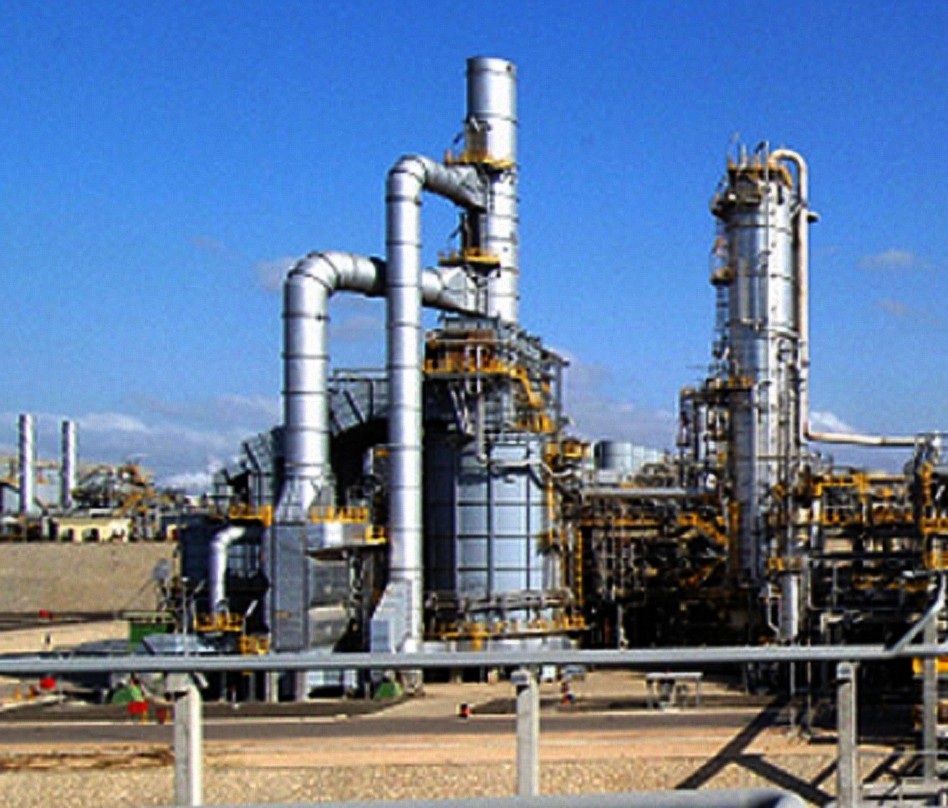
In many oil, gas, petrochemical and offshore facilities, heat exchangers are among the most critical components. In heat exchangers, the objective is to maximise heat transfer between two fluids within the smallest possible space while minimising the pressure loss required to transport the fluids through the exchanger. Further requirements include corrosion or chemical resistance of the heat exchanger material and the mitigation of ‘fouling’, which refers to the build-up of deposits or blockages in flow channels.
Meeting all the aforementioned requirements during heat exchanger development requires a high level of expertise in fluid dynamics and thermal engineering. For this reason, FlowMotion was commissioned to investigate the fluid mechanics of various helical heat exchanger tubes, both experimentally and through Computational Fluid Dynamics (CFD) simulations. This project primarily aimed to demonstrate the accuracy with which simulations can calculate heat transfer and pressure loss.
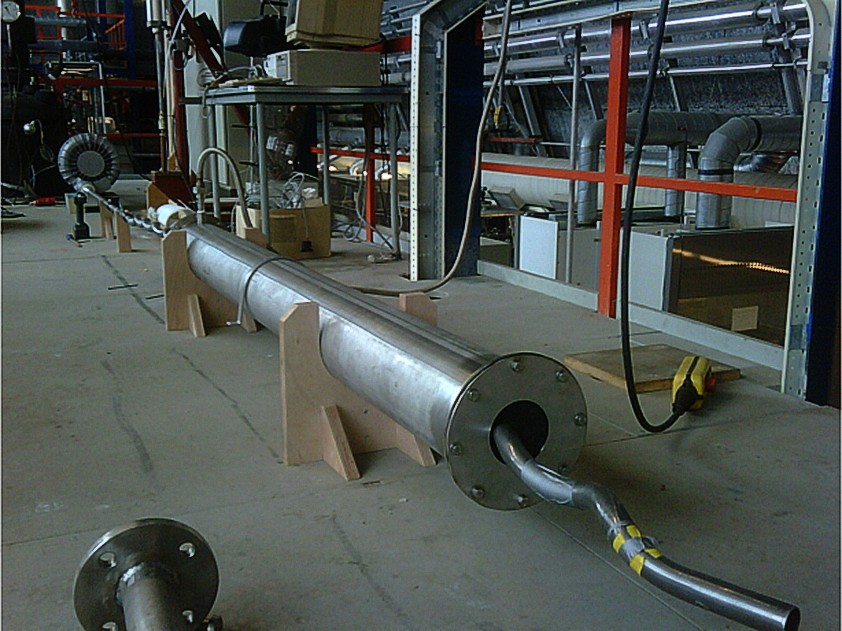
To compare experiments and simulations, identical flow and thermal conditions (e.g. constant volumetric flow rate, constant wall temperature, inlet velocity and temperature profiles, etc.) had to be established, and identical parameters (e.g. average pressure losses, local and mass-averaged temperatures at the outlet, etc.) had to be measured. These seemingly simple requirements could only be met with an exceptionally high experimental effort, necessitating the construction of a multi-metre long test rig.
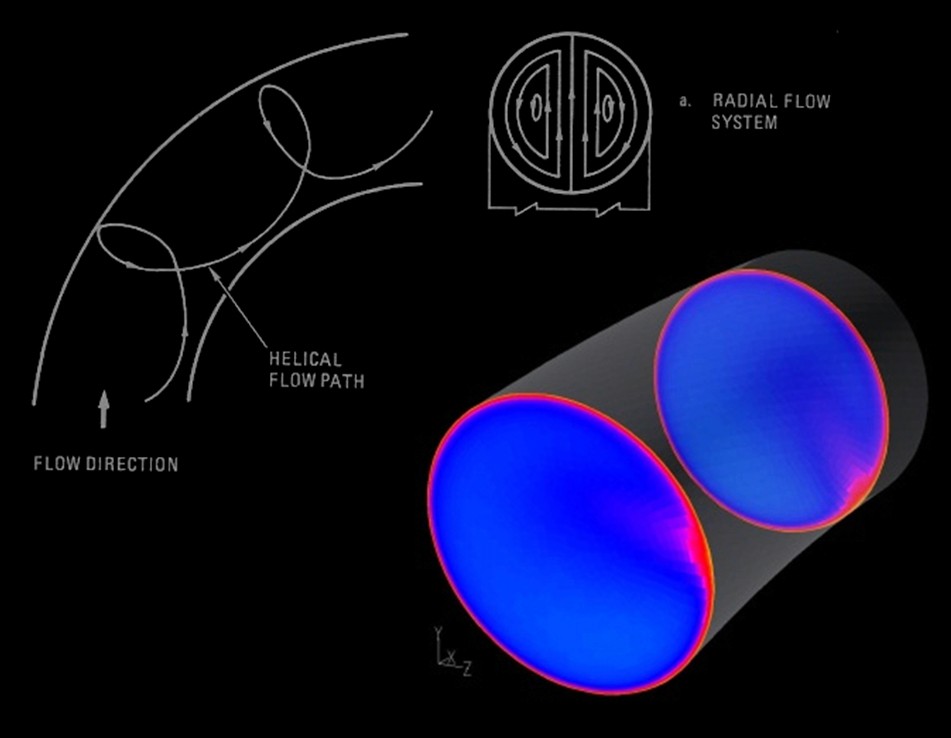
The fluid simulations also presented several challenges. This was due, in part, to the rotational flow patterns that occur within helical tubes, which cannot be captured by standard numerical methods, and, in part, to the requirement that all flow properties (e.g. density, viscosity, etc.) be treated as temperature-dependent. Furthermore, the mandatory mesh sensitivity analysis demonstrated that only an extremely fine grid would yield accurate results. These issues were resolved by developing a proprietary calculation method in which the entire tube was divided into individual segments.
At the conclusion of this multi-month project, a high degree of correlation was achieved between the experimental results and the simulation results for both averaged and local flow properties. The findings were presented in detail to an interested audience at the 9th European Congress of Chemical Engineering.