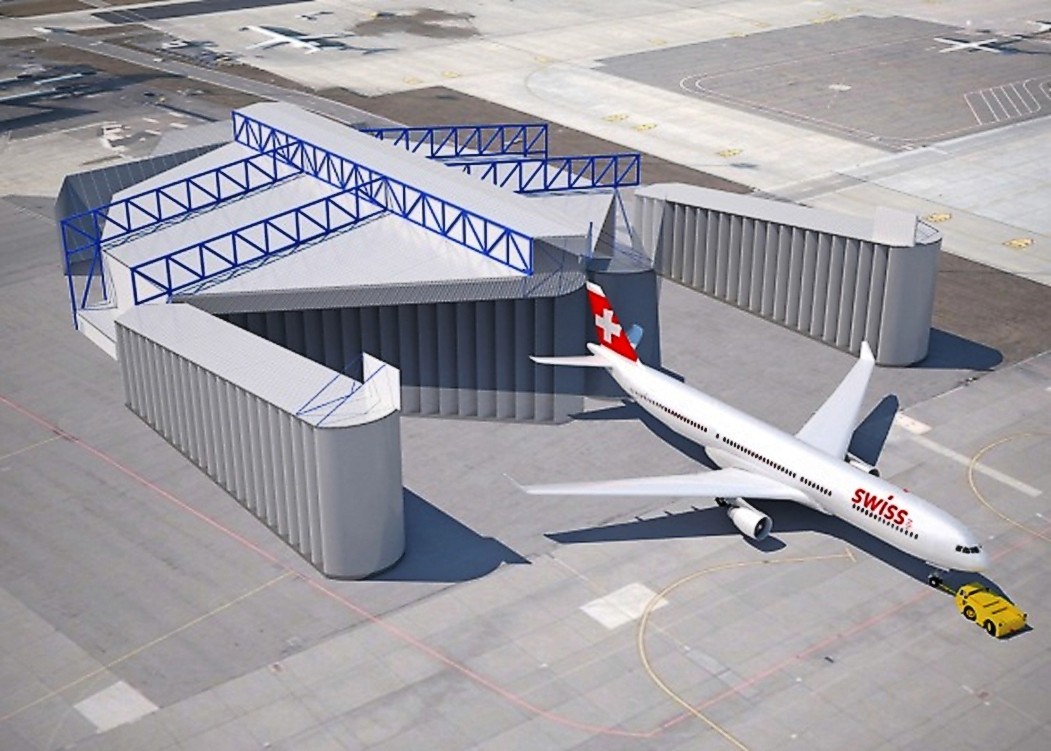
At an airfield, apart from the buildings visible to visitors, there are many others that are essential for smooth operations. One of these buildings is the engine run-up enclosure. In this enclosure, aircraft engines are tested for airworthiness following inspections or technical issues. To keep noise emissions during these tests as low as possible, the halls are highly sound-absorbent yet allow for airflow. The required supply air for the engines flows in from the front through acoustic baffles, and the exhaust jet is redirected at the rear by a ‘blast deflector’.
The difficulty in planning a noise protection enclosure is that, on the one hand, noise emissions must be minimised, while on the other, the hall must not influence the function of the engines under any wind conditions. To investigate the influence of the airflow around and through the hall on the engines during the planning phase, FlowMotion was commissioned to simulate the entire flow field using Computational Fluid Dynamics (CFD).
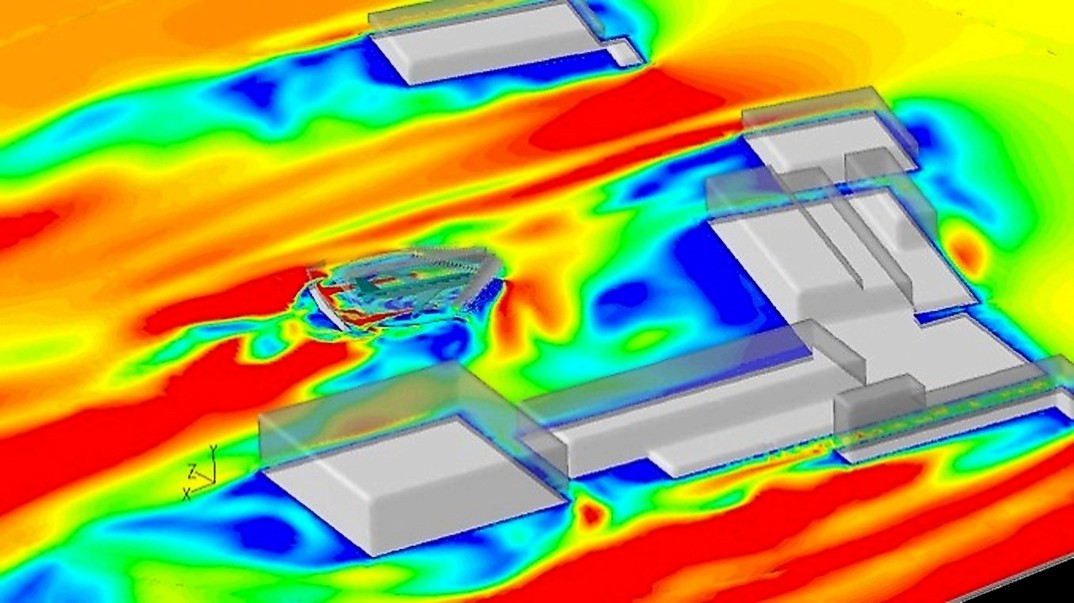
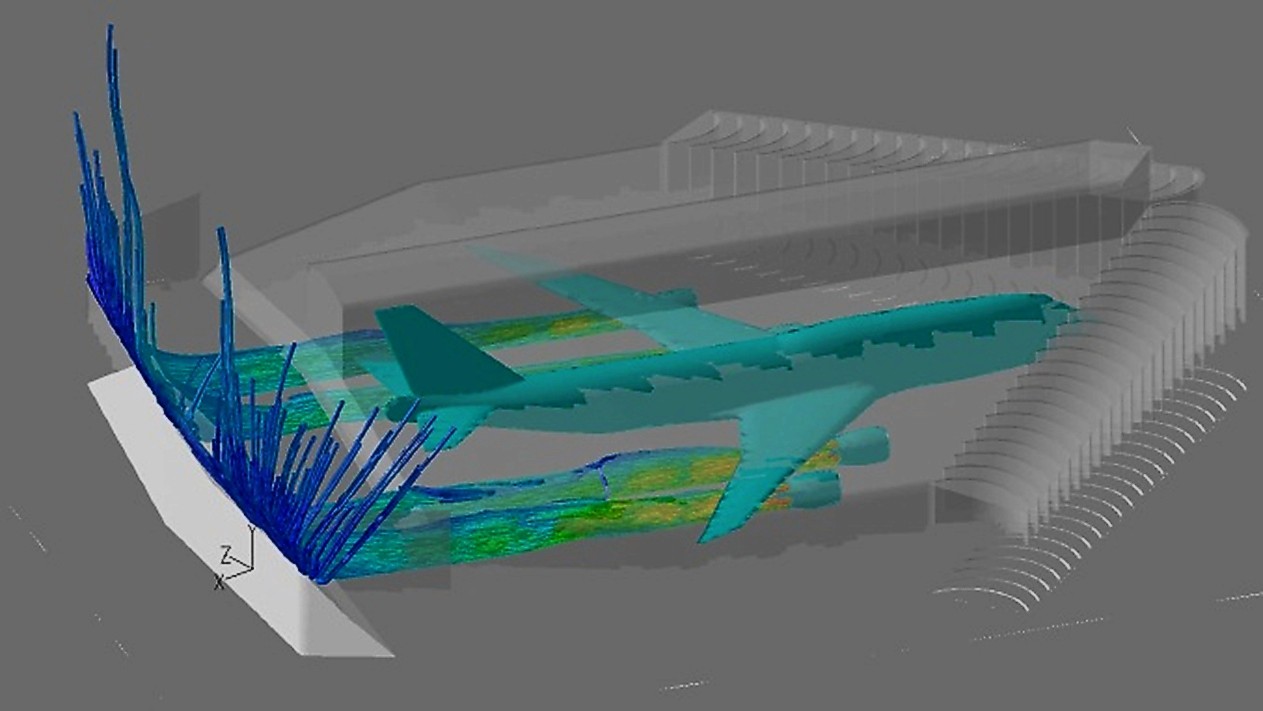
To provide a realistic representation of the airflow in the vicinity of the noise protection enclosure, not only the enclosure itself but also the surrounding buildings were modelled. The hall and the aircraft were represented with all aerodynamically relevant parts. Furthermore, particular emphasis was placed in the simulations on reproducing the velocity and temperature distribution of the real engines as accurately as possible.
The simulations were carried out for a wide range of combinations of wind direction, wind speed, roof structures, and engine settings. It was shown that no risks to the engines are to be expected in any of the simulations and that the noise protection enclosure planned by the WTM engineers meets all set objectives.