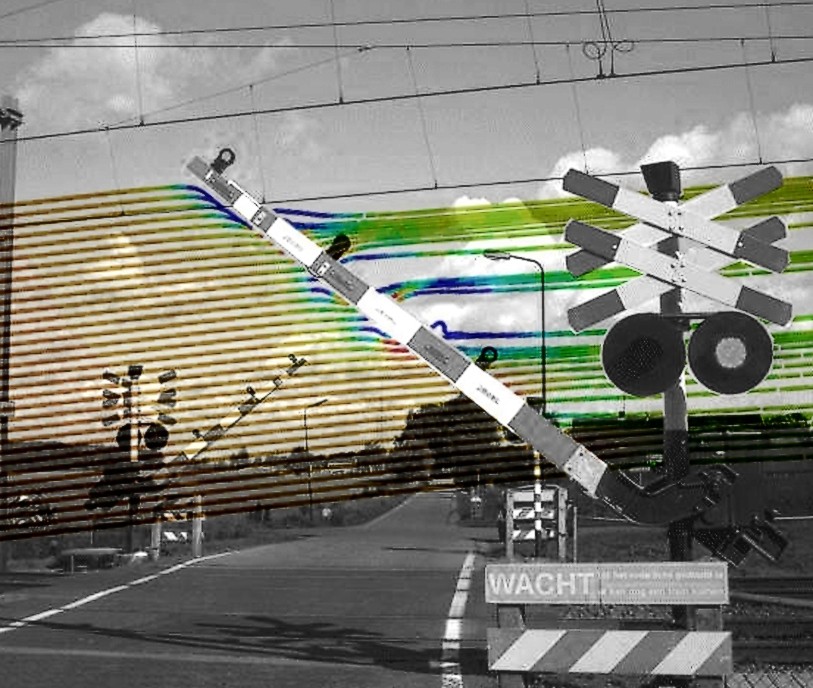
When railway barriers are developed, aerodynamics play a more important role than might initially be expected. Even under adverse wind conditions, a barrier must be able to move reliably into its safe horizontal position. The aerodynamic forces and moments acting on the barrier are therefore important design parameters.
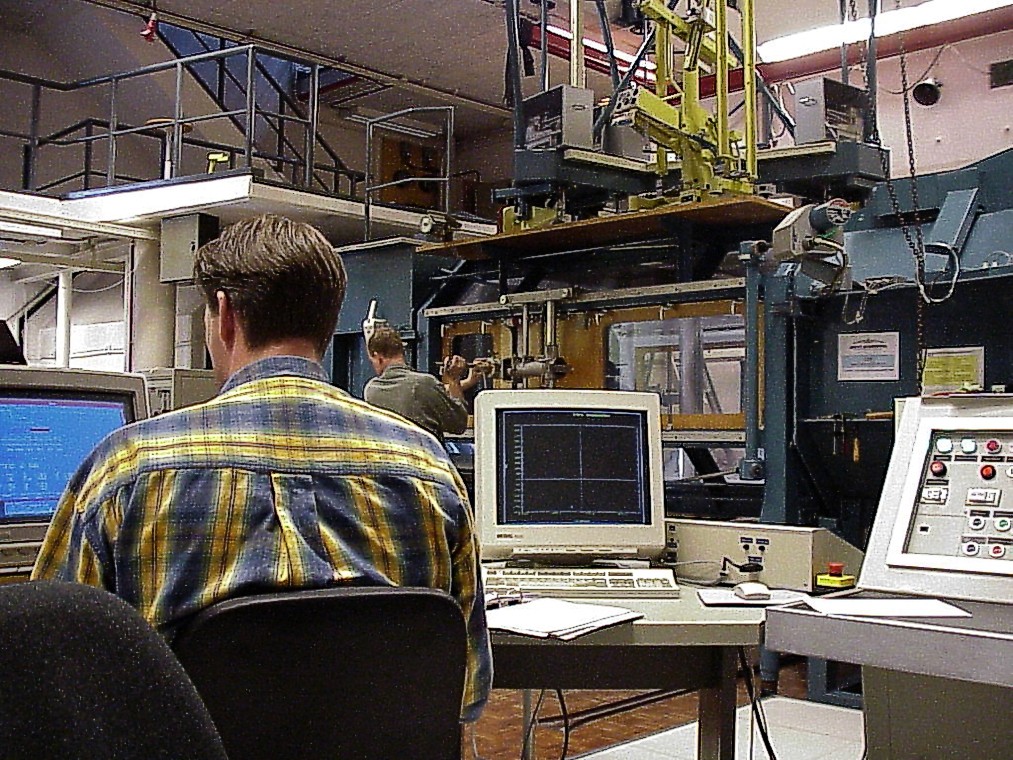
FlowMotion investigated these loads using both wind-tunnel measurements and CFD. In the wind tunnel, a one-metre section of the barrier was mounted on a force measurement system. This allowed the aerodynamic forces and moments to be measured for different wind velocities and angles of attack.
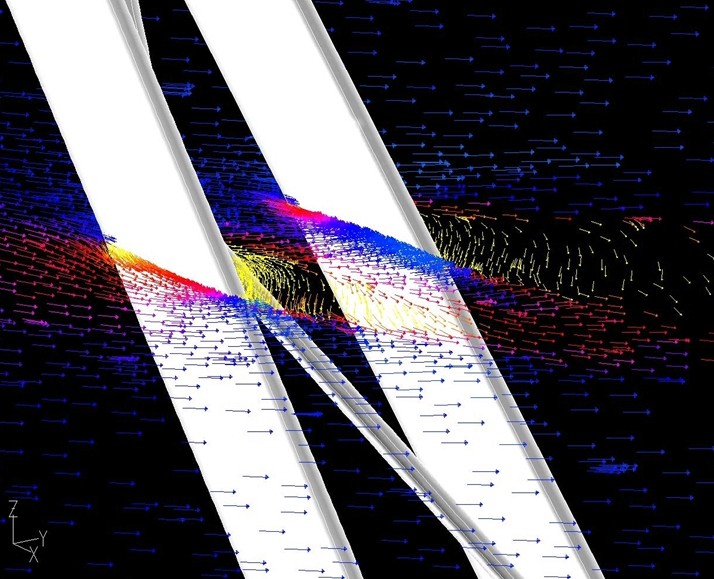
Because many combinations of barrier geometry, wind direction, wind velocity and barrier position had to be assessed—and because not all barrier positions could be tested practically in the wind tunnel—additional full-scale CFD simulations were performed. These calculations provided the pressure distribution around the barrier and the resulting aerodynamic forces and moments.
At the start of the numerical study, CFD results were compared with the wind-tunnel measurements. The agreement was sufficient for the objectives of the project, allowing the simulations to be used to investigate configurations that were difficult to test experimentally.
The calculations also revealed how small geometric details and three-dimensional end effects influenced the local flow field and the total aerodynamic loading. This combination of measurements and CFD provided the information required to assess and improve the aerodynamic behaviour of the barrier designs.