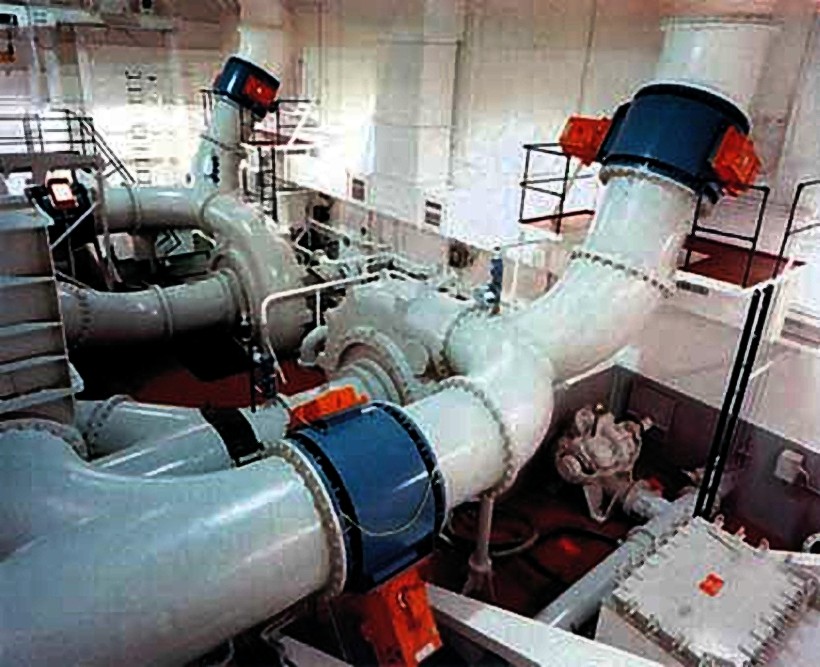
Large dredging vessels contain extensive piping and pumping systems within a limited installation space. Their design therefore requires a continuous compromise between compact installation and favourable flow conditions.
Bends, contractions and other pipe components can strongly disturb the velocity profile. Downstream of a bend, the flow is generally not immediately fully developed: the velocity profile can be asymmetric and secondary flows may be present. If a pump is installed shortly downstream of such a disturbance, the impeller can therefore be subjected to a non-uniform inlet flow.
FlowMotion investigated the inlet flow to several centrifugal pumps on board dredging vessels. The study was prompted by severe pump vibrations that reduced service life. One possible cause was an unfavourable velocity and pressure field at the pump inlet resulting from upstream bends. Such non-uniform inflow can affect pump loading and can locally increase the risk of cavitation if the static pressure falls sufficiently.
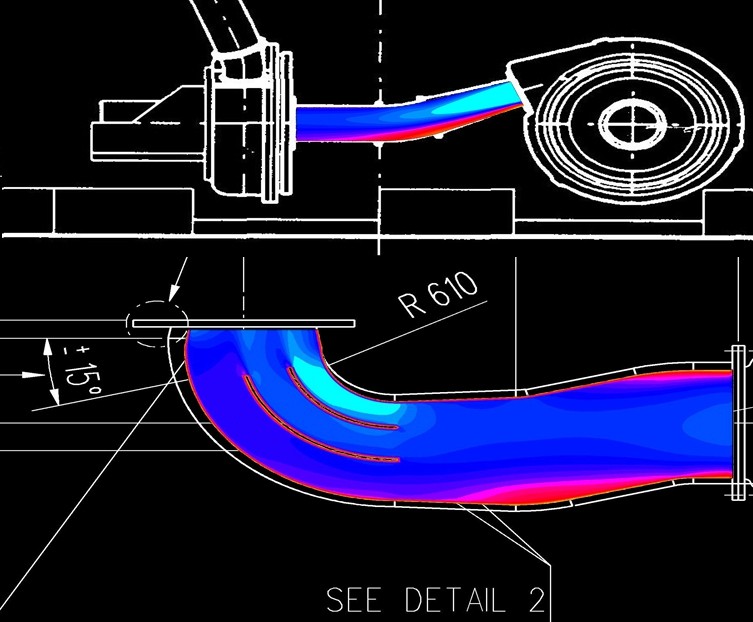
Because local velocity measurements in these piping systems were difficult to perform, several pipe and bend configurations were analysed with CFD. The simulations revealed the three-dimensional velocity distribution and secondary flow structures upstream of the pumps.
The analyses showed that bend geometry could have a strong influence on the velocity profile at the pump inlet. The effect of this non-uniform inflow on the pump characteristic and cavitation behaviour was subsequently investigated in more detail.