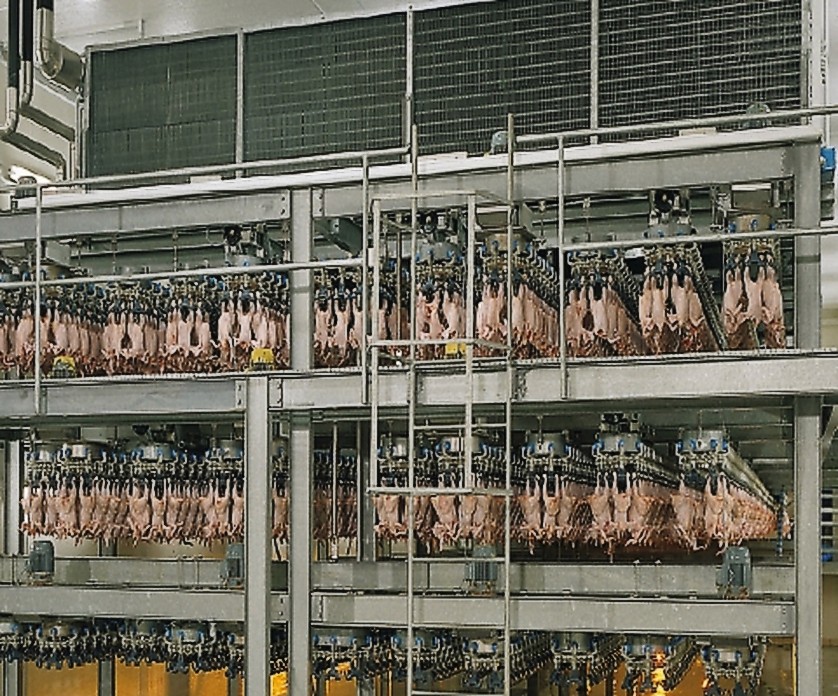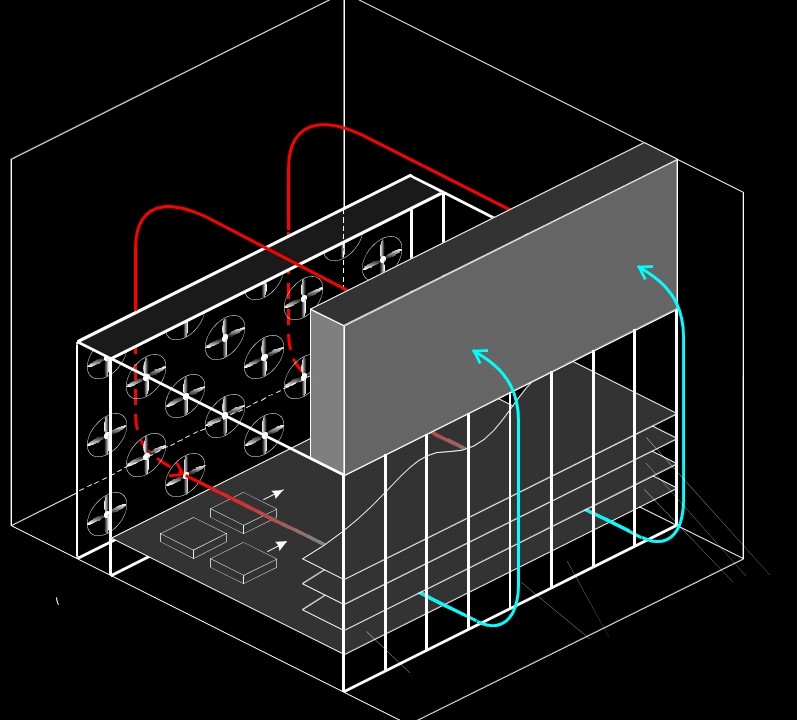
An industrial cooling or freezing system in the food-processing industry often consists of a large enclosure through which products are transported on conveyors. Fans circulate the cold air, while heat exchangers maintain the required air temperature. The local air velocity around the products, together with the air temperature, strongly affects heat transfer and therefore the time required to reach the specified core temperature.
Such systems are often designed using an assumed minimum air velocity that is treated as uniform for all products. FlowMotion examined this assumption both theoretically and experimentally, including air-velocity measurements while the installation was operating.
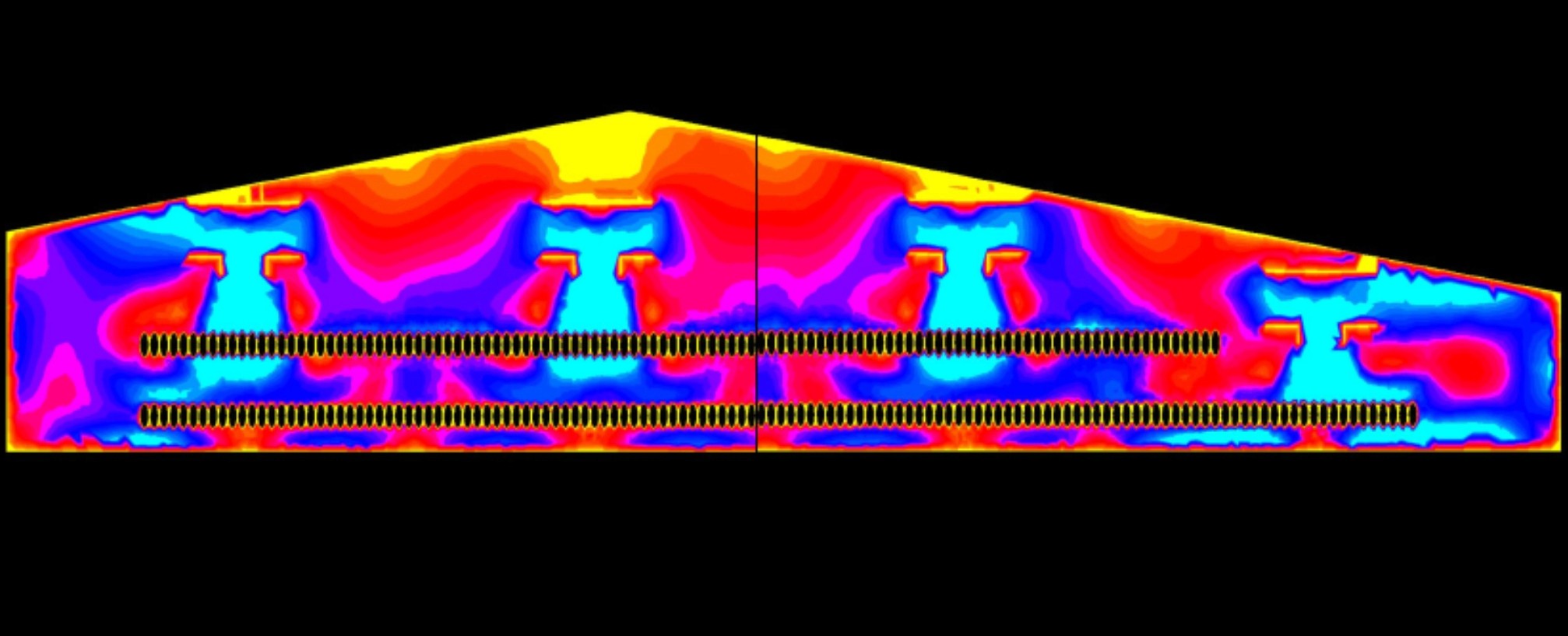
The measurements showed that the airflow was not uniformly distributed in practice. Local differences in air velocity therefore caused differences in heat transfer. In the most unfavourable locations, individual products could fail to reach the required core temperature within the available residence time.
Different configurations were then evaluated with CFD before physical modifications were made. The simulations were used to investigate how the position of internal components and changes to the geometry affected the airflow distribution.
The calculations showed that targeted positioning of the internal components and modifications to the geometry could make the air-velocity distribution substantially more uniform. A more homogeneous airflow provides better control of heat transfer to the products and can improve both product quality and the energy efficiency of cooling and freezing systems.