Safe Nuclear Containers

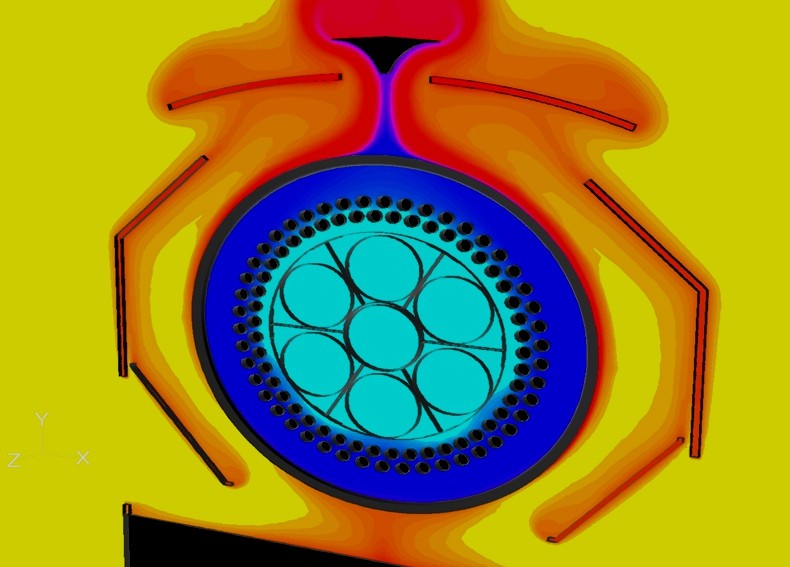
Analysis of heat dissipation for the Castor nuclear waste cask (flow simulations)

The decommissioning of nuclear power plants and the unresolved search for a final repository have created a significant demand for containers for the transport and interim storage of high-level radioactive waste.

These ‘Castor’ casks are subject to the strictest safety requirements, including mechanical integrity (even in the event of a catastrophe), nuclear shielding, and heat dissipation. Due to the interaction of these requirements, the development and design of nuclear containers require a multidisciplinary team of experts from the fields of physics, materials science, mechanics, and fluid mechanics. FlowMotion was engaged to contribute expertise in fluid mechanics and thermal engineering to the team and to address the challenge of optimal heat dissipation.

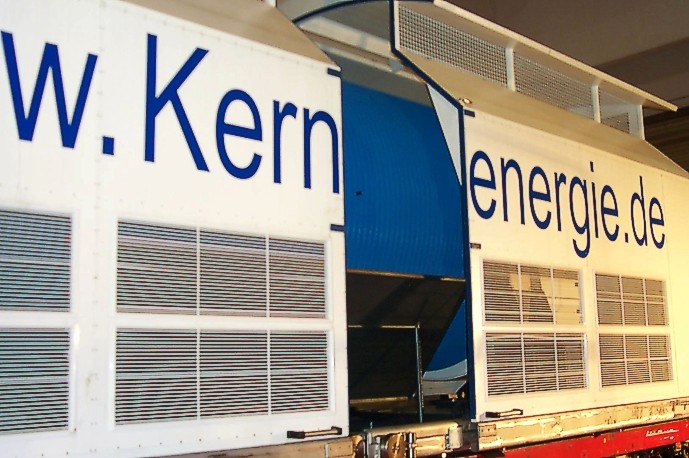
Heat dissipation plays a crucial role in nuclear containers. The fuel elements inside the container generate heat due to residual radioactive decay, which must be dissipated to the outside. Nuclear containers are designed to ensure the integrity of the structure and compliance with permissible temperatures at all times. Furthermore, excessive container surface temperatures pose a risk to the environment. For this and other reasons, Castor casks are protected by a transport hood during transit. As this hood has a strong influence on the container’s heat dissipation, the thermal interaction between the container and the hood is taken into account during planning and design.

Using Computational Fluid Dynamics (CFD), the entire flow and temperature field inside and outside the container and the transport hood can be calculated. These simulations account for heat radiation, thermal conduction, and free convection within individual components. The aim of this approach is to calculate and evaluate the local temperatures of the entire container with high accuracy, rather than mere approximation, during the design phase.

Beyond this application, CFD calculations open up new possibilities for optimising the shape of the container and hood regarding heat dissipation, ensuring that future transport and storage of fuel elements with higher thermal output can be accommodated.

GNB
GNB
GNB