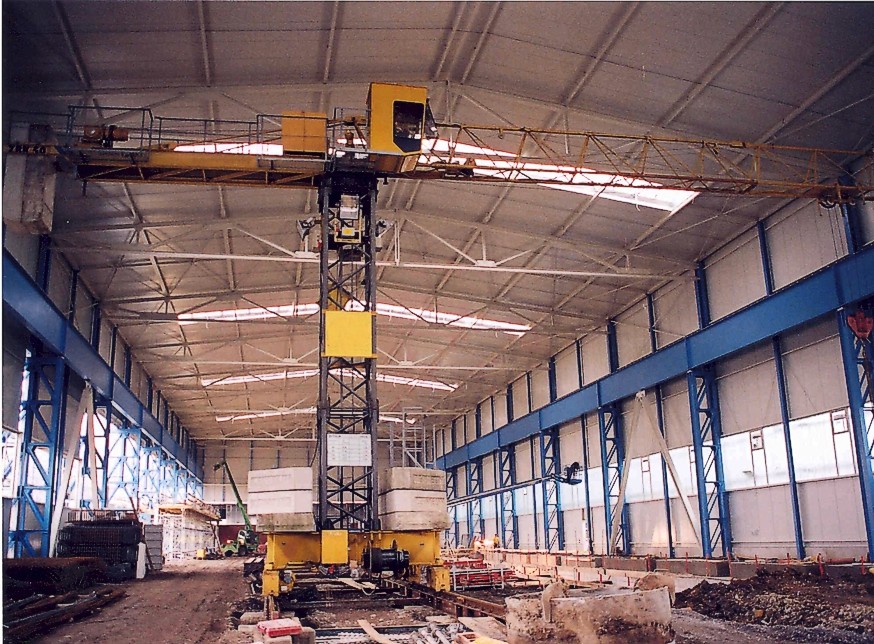
Within a large-scale project, the ventilation for a compressor hall was to be planned. In this hall, an electrically driven compressor system was used to compress natural gas, which was then stored in tanks before being fed into the public grid via acoustic filters.
During the compression process, the compressor, electric motor, and other components release large amounts of thermal energy into the hall’s air. To prevent technical equipment from overheating and causing operational failures, it was necessary to ensure during the planning phase that the ventilation system could dissipate the generated heat load and that a specific critical temperature in the hall air would not be exceeded.
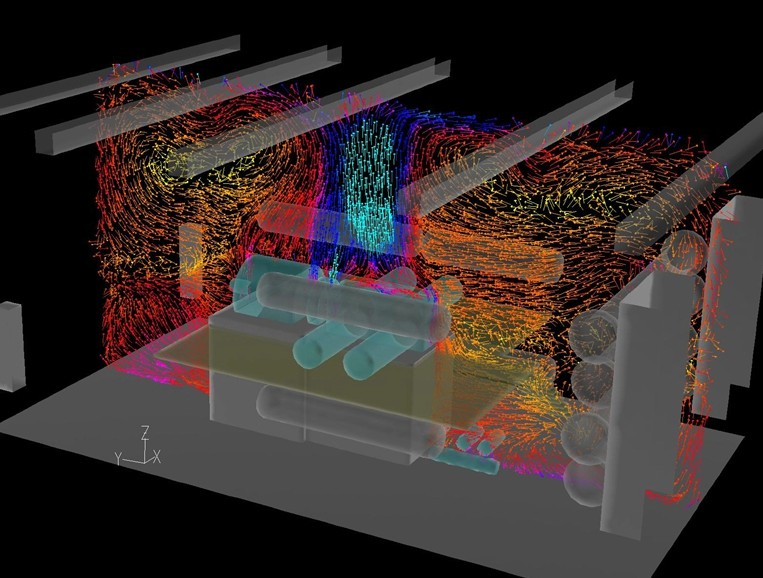
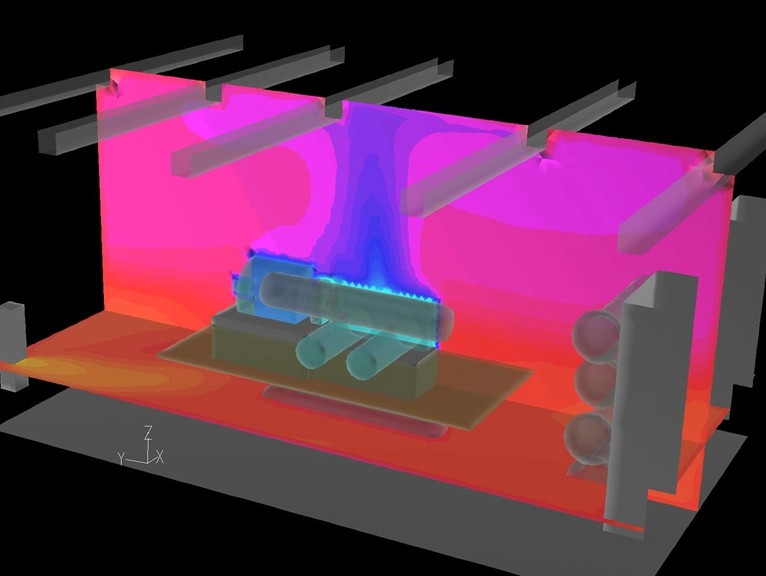
Due to the very high heat load and the complex geometric configuration of the equipment, FlowMotion was commissioned to simulate the airflow and resulting temperature distribution using Computational Fluid Dynamics (CFD). Given that the advantages of simulations include the ability to flexibly examine various scenarios in detail, the decision was made to virtually test different concepts across a range of weather conditions to maximise planning reliability. In these simulations, significant differences in air density were anticipated. Therefore, particular attention was paid to the influence of the generated free convection currents (updraft and downdraft of air). Heat dissipation through thermal radiation was also taken into account.
A detailed analysis of the results for the basic ventilation design, supported by animations of the airflow within the hall, demonstrated that the influence of free convection currents is dominant, particularly on winter days, which led to significant stratification of the air temperature. Using the knowledge gained from the CFD calculations, new concepts were developed to counteract the disruptive physical effect of warm air buoyancy and to achieve sufficient cooling.
This demonstrates that by using flow simulations with the same total volume flow, and therefore identical operating costs, higher operational reliability can be guaranteed as early as the planning phase.