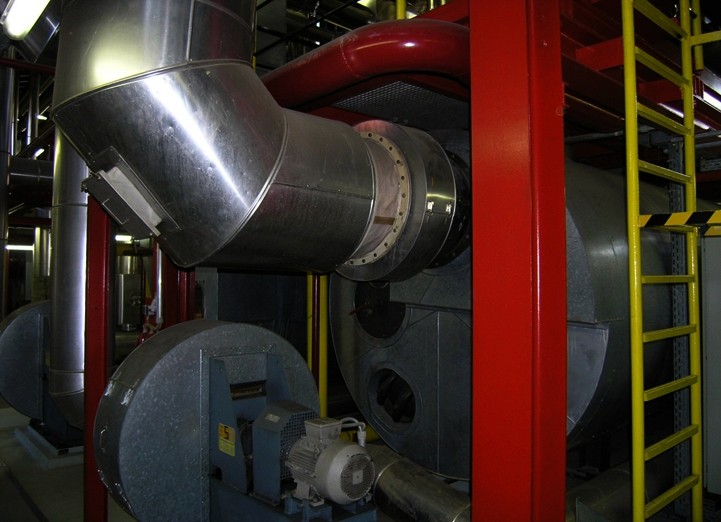
A hospital boiler installation must discharge flue gases safely while meeting strict acoustic requirements. Installing a silencer reduces noise, but it also introduces an additional pressure loss into the flue-gas system.
FlowMotion used CFD to dimension a silencer for the boiler installation. The available driving pressure is influenced by chimney draft: hot flue gas has a lower density than the cooler surrounding air, creating a pressure difference over the height of the chimney.
This available pressure difference must overcome the pressure losses in ducts, bends, the silencer and other components. The flue-gas volumetric flow therefore follows from the balance between chimney draft and the total system resistance.
The calculations provided the local velocity and static-pressure fields and quantified the pressure loss across alternative silencer configurations. This made it possible to satisfy the acoustic requirement without unnecessarily restricting the flue-gas flow.
The result was a silencer design based on the actual thermal and aerodynamic behaviour of the complete boiler and chimney system.