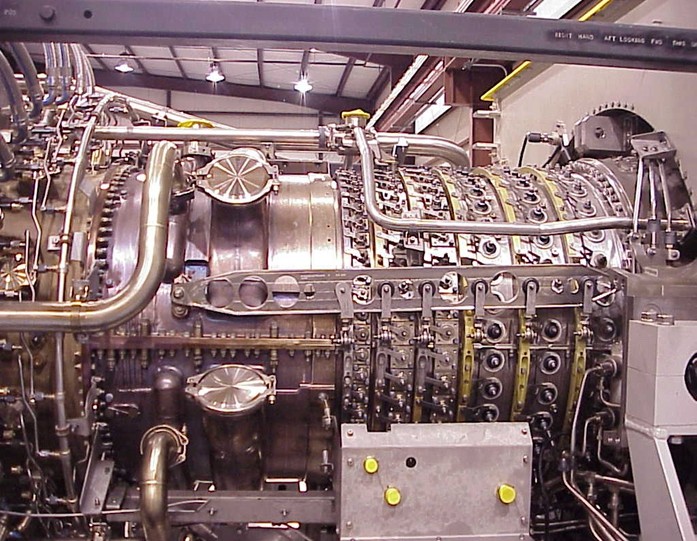
Modern gas turbines are housed in enclosures that incorporate air intakes for combustion, as well as exhaust systems equipped with silencers, filters, fans, and anti-icing systems. Designing the ventilation system for such a gas turbine enclosure is particularly complex due to the multitude of diverse requirements.
Primarily, the turbine enclosure must shield the surrounding environment from the turbine’s immense heat and noise. Some turbines emit up to 1 MW of thermal energy. However, the enclosure’s protective insulation leads to high internal temperatures, which can cause overheating and result in costly emergency shutdowns. Therefore, the ventilation must ensure sufficient cooling of the turbine. Furthermore, the ventilation system must ensure that gas escaping from a potential leak is removed from the enclosure, reducing the likelihood of an explosion from an unventilated gas cloud within the enclosure to an absolute minimum under all circumstances.
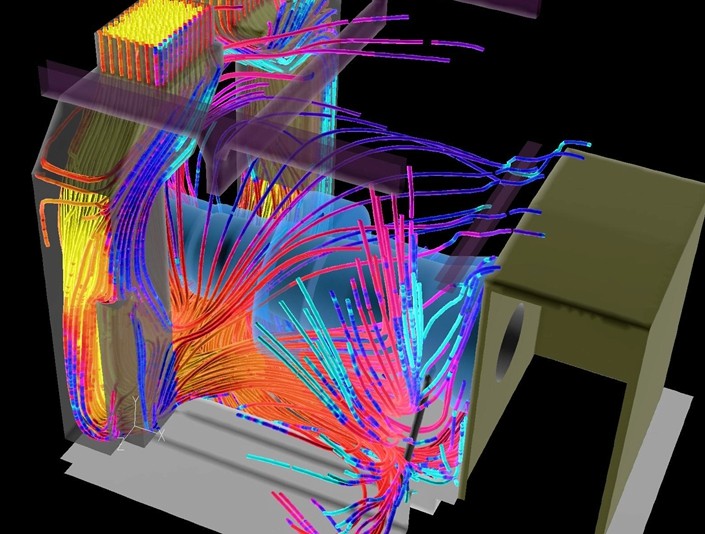
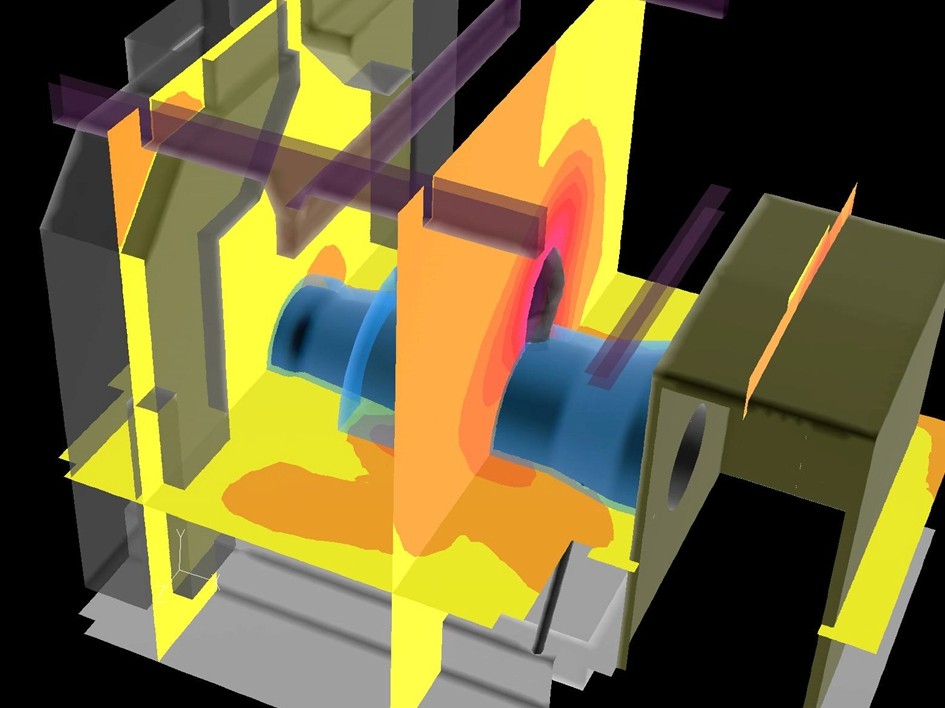
Given that the requirements for the ventilation system regarding cooling and gas extraction can be highly contradictory, FlowMotion was commissioned to investigate the airflow within the gas turbine enclosure. As the enclosure development was still in the planning phase, Computational Fluid Dynamics (CFD) simulations were utilised for this study. A virtual 3D model, including the turbine and air ducts, was constructed for the simulation. The influence of the numerous turbine supply lines on airflow and heat dissipation (including thermal radiation) was modelled using ‘porous blocks’.
Analysis of the results enabled the calculation of the highly complex structure of velocity and temperature distribution, while keeping gas concentrations within the enclosure below the mandatory safety limits (ATEX).