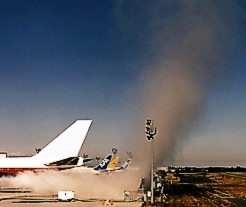
Aircraft engines are required to undergo test runs according to regulations. Due to the engine exhaust, people, machinery, buildings, and other aircraft can be adversely affected. To prevent this, blast deflectors are installed. These deflect the engine exhaust upwards, mitigating the risk of accidents and damage, and also help to reduce ambient noise. In addition to the structural and thermal challenges involved in developing a blast deflector, its position and distance are of critical importance. If the blast deflector is too close to the aircraft, the diverted hot engine exhaust can damage the horizontal and vertical stabilisers. If the distance is too great, parts of the exhaust stream can bypass the deflector and still pose a hazard.
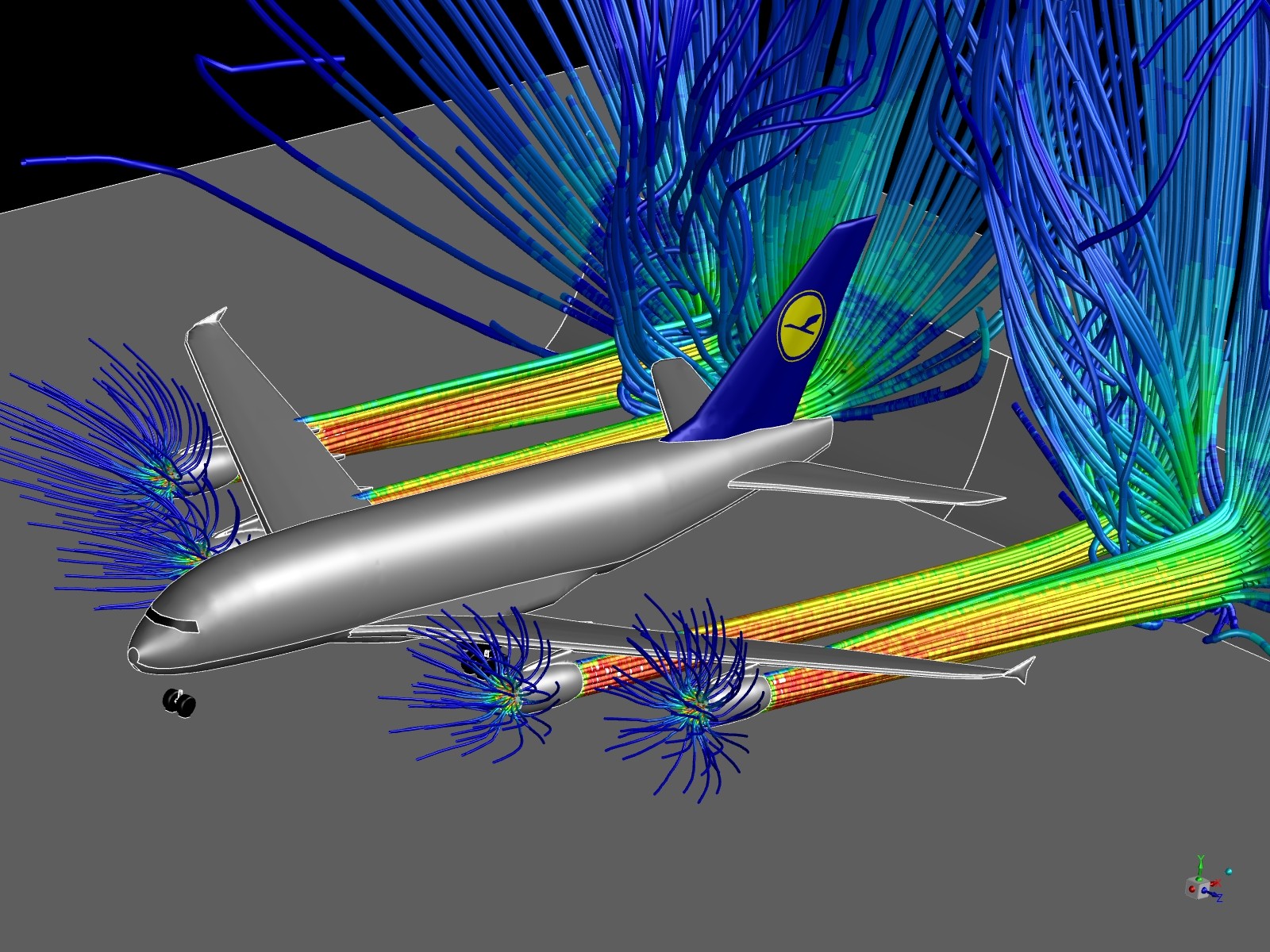
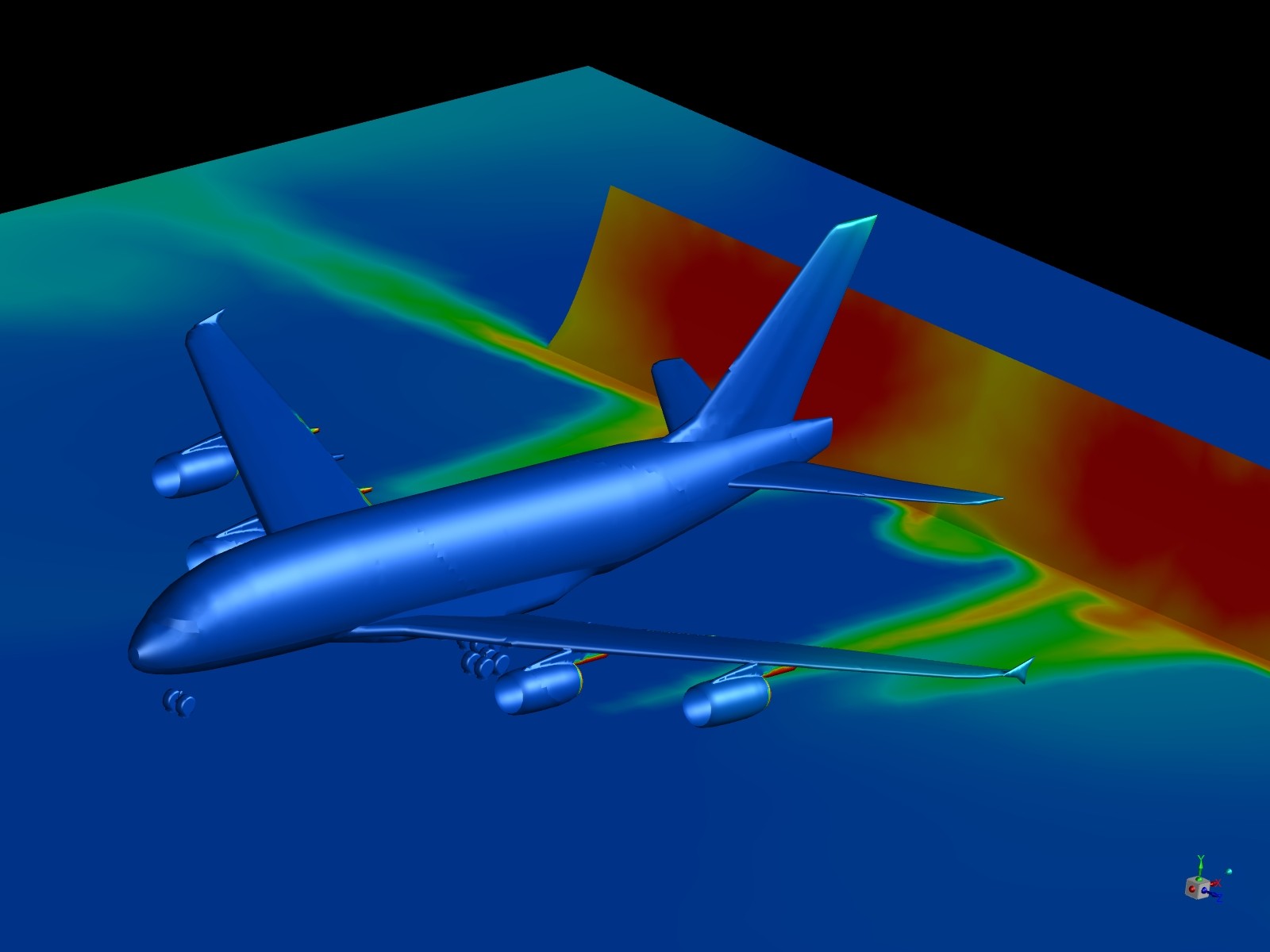
In the case presented here, a blast deflector is being developed and built for Frankfurt Airport for the new Lufthansa Airbus A380. Flow simulation (Computational Fluid Dynamics - CFD) is used to determine the optimal position. To this end, FlowMotion created a complete computer model of the A380 and the flow generated by the engines. These simulations were carried out for a range of scenarios.
As CFD calculations provide all local flow variables throughout the entire computational domain, the analysis of the velocity, temperature, and static pressure fields in the vicinity of the horizontal and vertical stabilisers allowed for the determination of the optimal positions for the blast deflector for the A380, as well as for other aircraft types. This enabled the aircraft mounting points on the blast deflector apron to be defined.