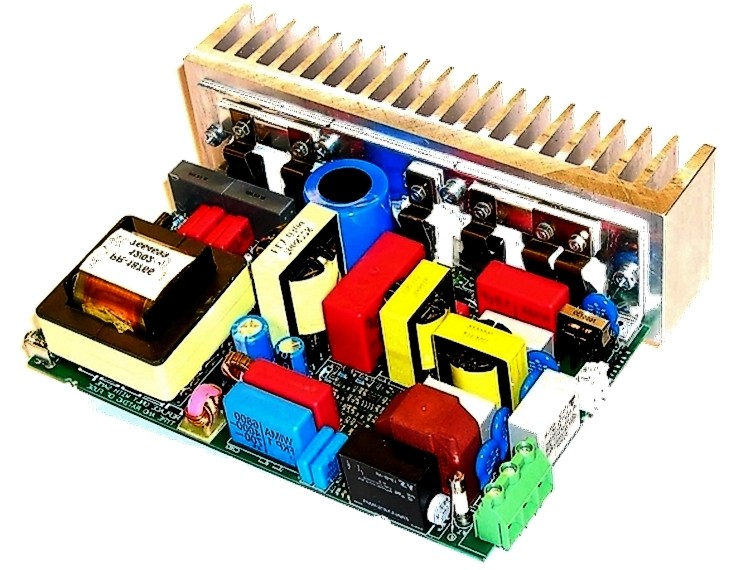
In almost all electronic systems, a multitude of components are accommodated in the tightest of spaces, some of which dissipate large amounts of heat. Since the market demands increasingly powerful technology within ever-smaller installation spaces, the optimisation of heat dissipation is an ongoing process.
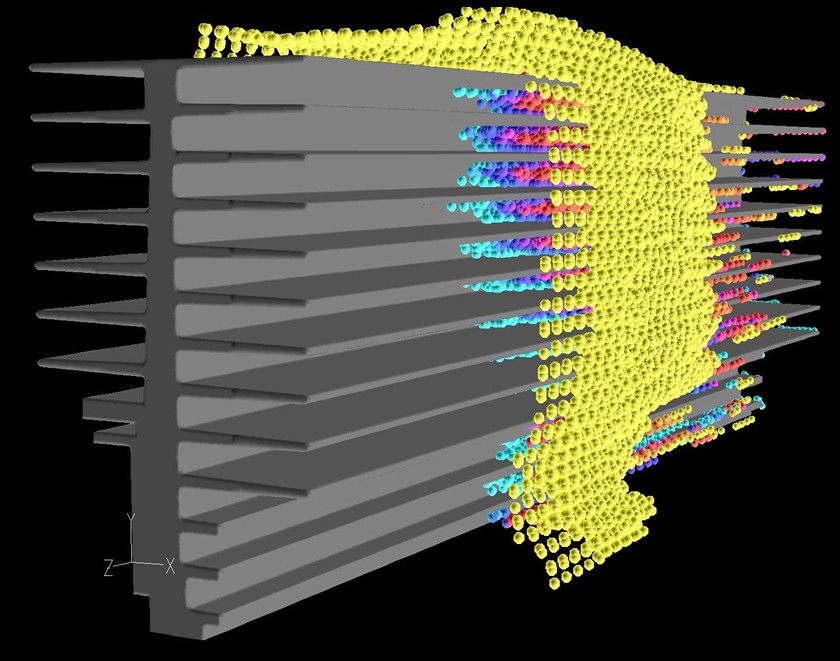
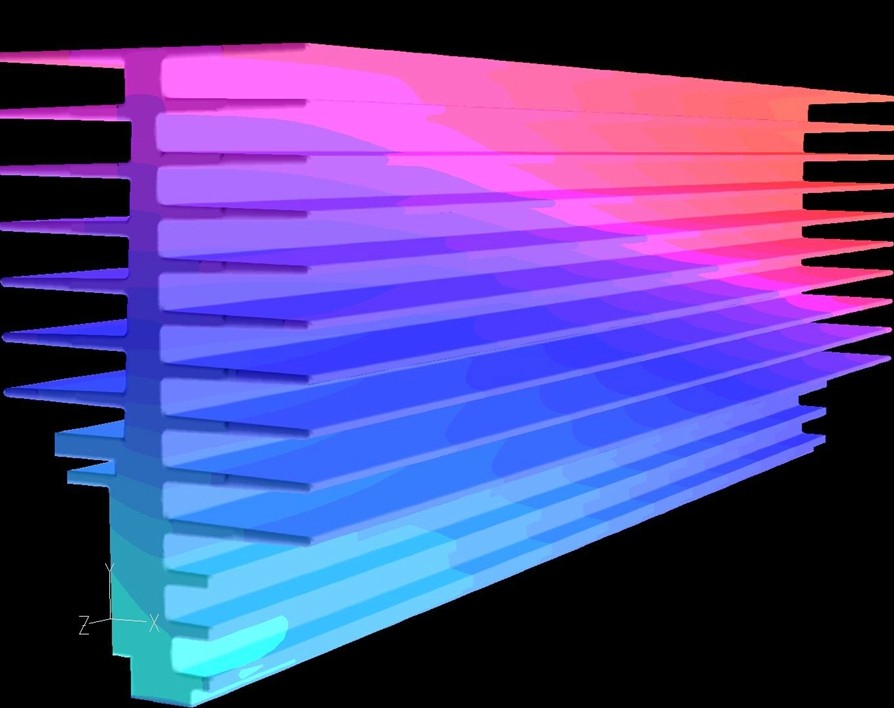
In this context, FlowMotion was commissioned to optimise a finned heat sink in terms of heat dissipation and size. To obtain as much information as possible regarding the airflow along the heat sink, the temperature distribution within the heat sink, and the resulting heat dissipation, flow simulations (CFD calculations) were selected as the investigation method.
During flow simulations of cooling fins, a 3D model of the solid heat sink and the surrounding air is created. Subsequently, the computational grid is generated, which is of particular importance for heat transfer calculations to achieve sufficient simulation accuracy. Furthermore, these CFD calculations accounted for heat conduction within the heat sink, thermal radiation, and the temperature dependency of air properties.
In the field of processor cooling, CFD calculations offer the advantage of investigating a heat sink’s characteristics with lower costs and time expenditure, and with a much greater information density, compared to prototype construction including measurements. Therefore, a multitude of heat sink variants were simulated. The analysis of the simulation results led to a deeper insight into the fluid-mechanical processes, and it was possible to demonstrate which geometric parameters of the heat sink led to maximum improvement of the desired characteristics.