The increasing computing power of servers results in ever higher heat loads in data centres and server rooms. Reliable operation therefore requires not only sufficient cooling capacity, but above all an effective distribution of the cooled air. Poor airflow distribution can lead to locally high server inlet temperatures and consequently to thermal problems.
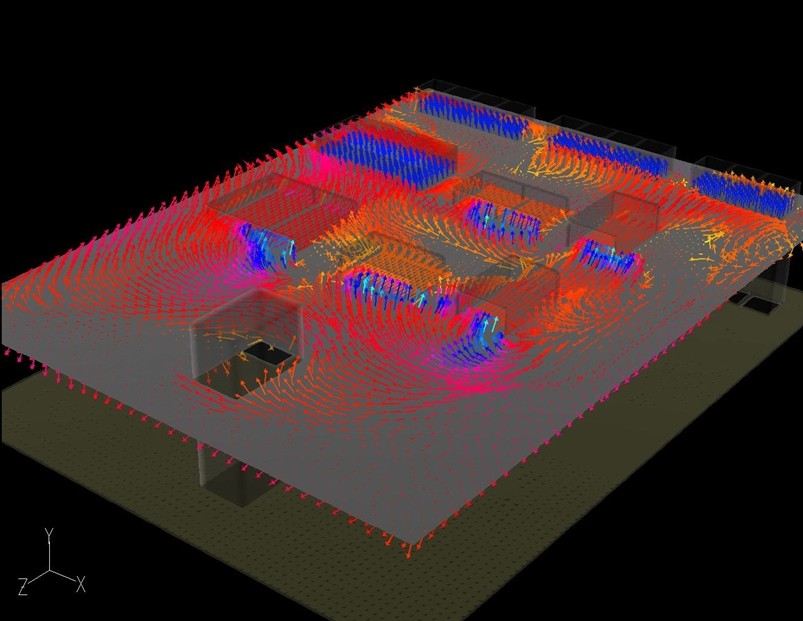
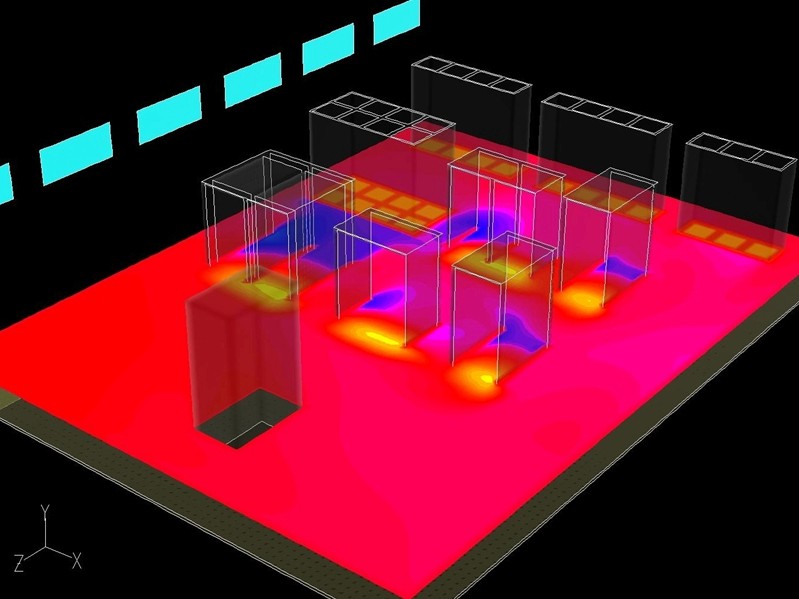
FlowMotion used CFD to analyse the airflow and temperature distribution in a server room. The three-dimensional model included the flow-relevant details, such as server cabinets and racks, supply and extract openings, the raised floor and the operating conditions of the climate-control system.
The calculations showed how the cooled supply air was distributed through the room and how warm exhaust air spread from the servers. Natural convection caused by temperature-dependent density differences was also taken into account and, where relevant, thermal radiation.
The calculated velocity and temperature fields made it possible to identify unfavourable flow patterns, such as recirculation of warm air or insufficient air supply to particular racks. The influence of the positions of server cabinets, racks and air openings on cooling performance could then be assessed.
This approach makes it possible to use the available cooling capacity more effectively and improve operational reliability without necessarily installing additional cooling capacity.