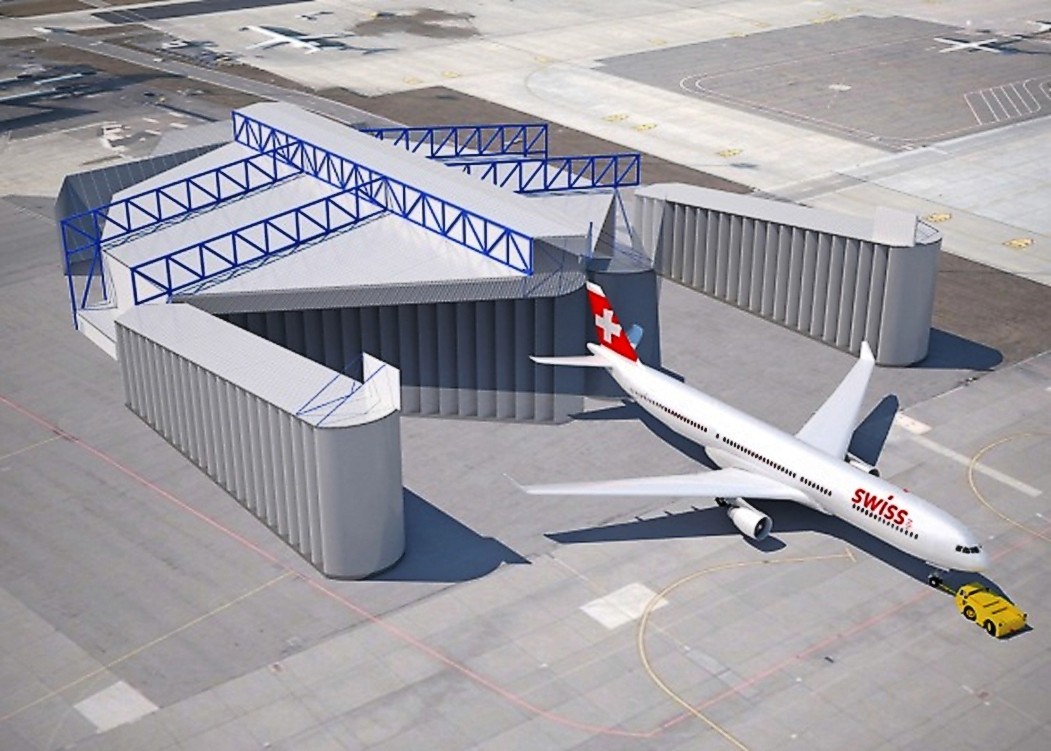
Airports require facilities in which aircraft engines can be tested after maintenance or when faults are investigated. A ground-run enclosure must reduce noise emissions while still providing sufficient air to the engines and safely discharging the hot exhaust gases.
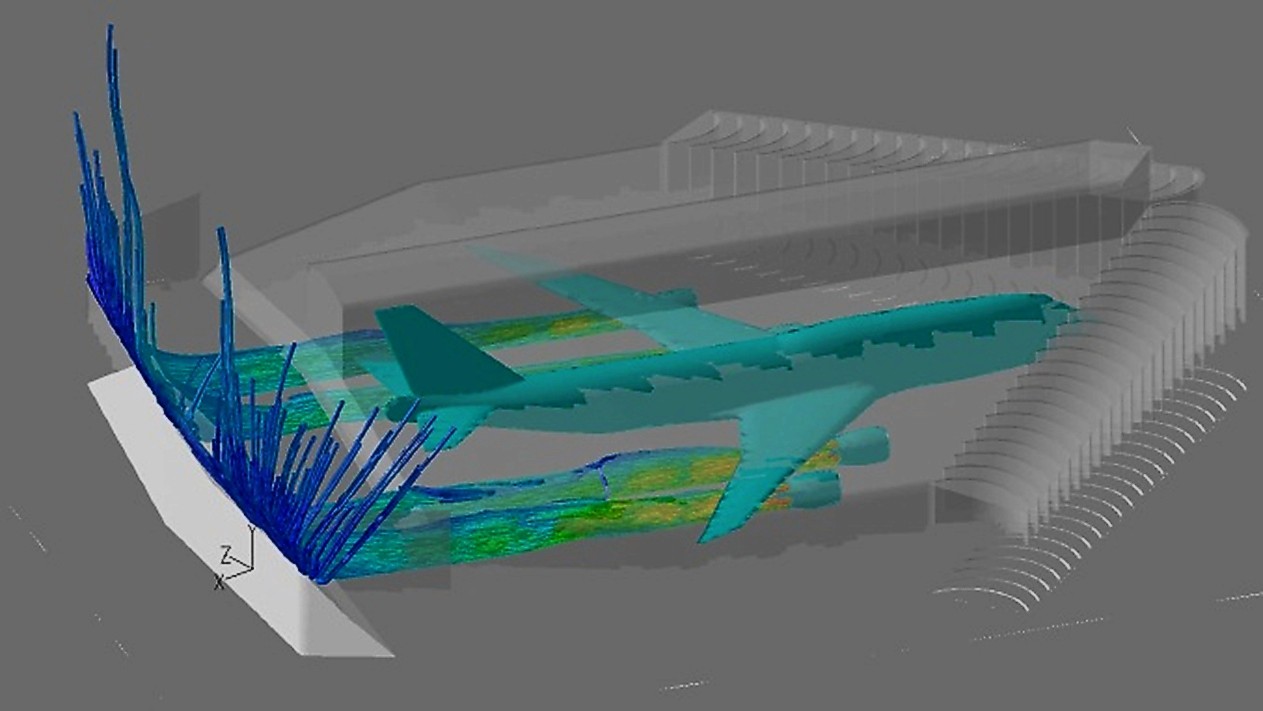
The engines draw combustion air through acoustically treated, flow-permeable structures at the front of the enclosure. At the rear, the hot exhaust jet is redirected by a blast deflector. The design must prevent external wind conditions or recirculation of exhaust gases from adversely affecting the airflow into the engines.
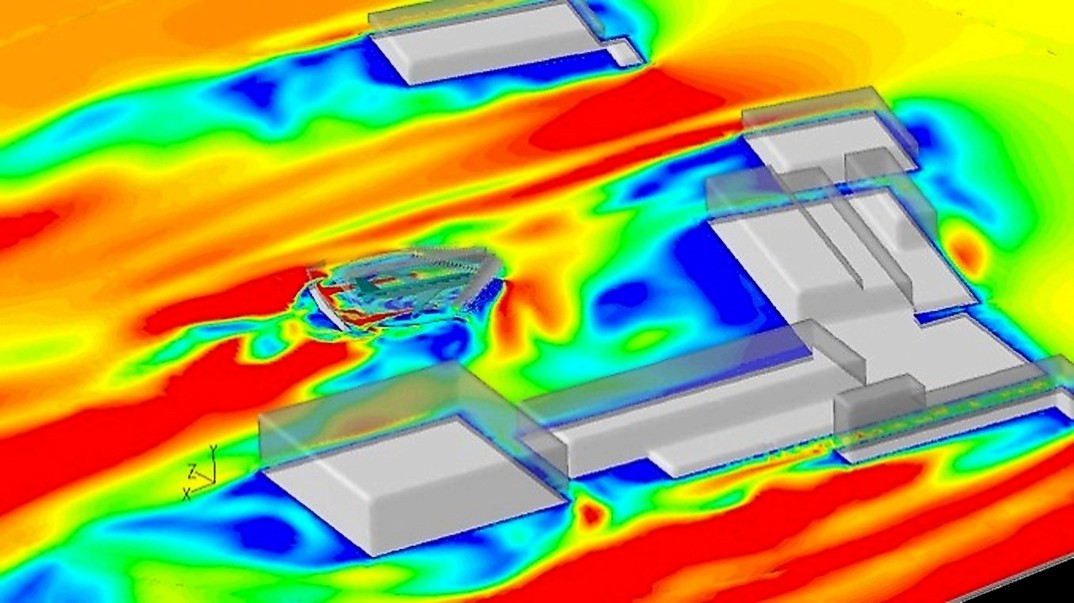
FlowMotion therefore used CFD to calculate the complete airflow around and through the enclosure. The surrounding buildings were included in the computational model to reproduce the external wind field realistically. The enclosure and aircraft were modelled with the aerodynamically relevant geometric details, while the engine exhaust velocity and temperature distributions were represented as realistically as possible.
Simulations were performed for different combinations of wind direction, wind speed, roof configuration and engine operating condition. This made it possible to study the interaction between the external airflow, the air supply to the engines and the discharge of the hot exhaust gases.
For the configurations investigated, the calculations showed no airflow conditions expected to endanger the engines. The ground-run enclosure designed by WTM therefore met the specified aerodynamic design objectives.