The cooling capacity of an air-conditioning unit depends not only on the heat exchanger and fan, but also on how efficiently the air moves through the complete internal flow path. Poor distribution and unnecessary pressure losses can reduce the delivered airflow and therefore the useful cooling performance.
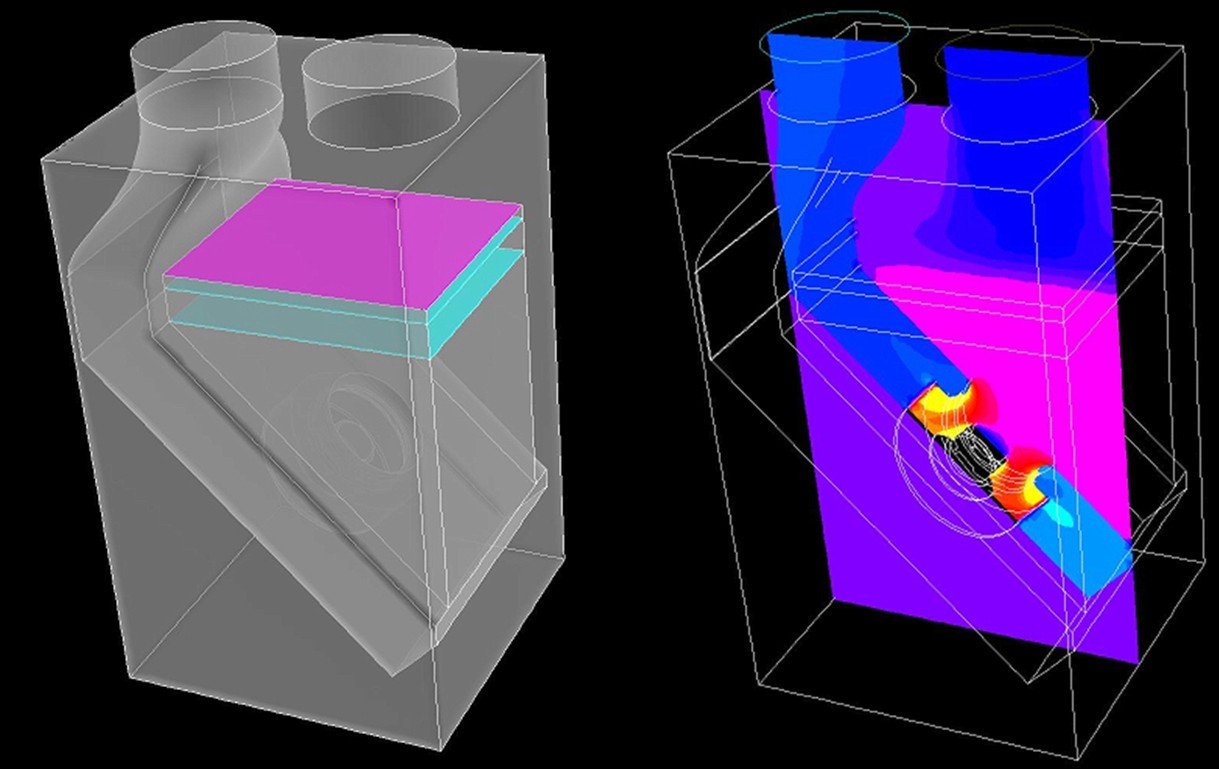
FlowMotion used CFD to analyse the internal airflow of an air-conditioning unit. The simulations provided the local velocity and static-pressure fields through the casing, heat exchanger and other flow-relevant components.
Regions with strong acceleration, separation or recirculation could be identified and related to their contribution to the total pressure loss. The calculations also showed how uniformly the available airflow was distributed over the heat-exchanger surface.
Different internal geometries could then be compared quantitatively. Reducing unnecessary aerodynamic losses allows a larger volumetric flow for the same fan operating point, or the same airflow at lower fan power.
The CFD analysis provided a direct route to improving both airflow performance and cooling effectiveness without simply selecting a larger fan.