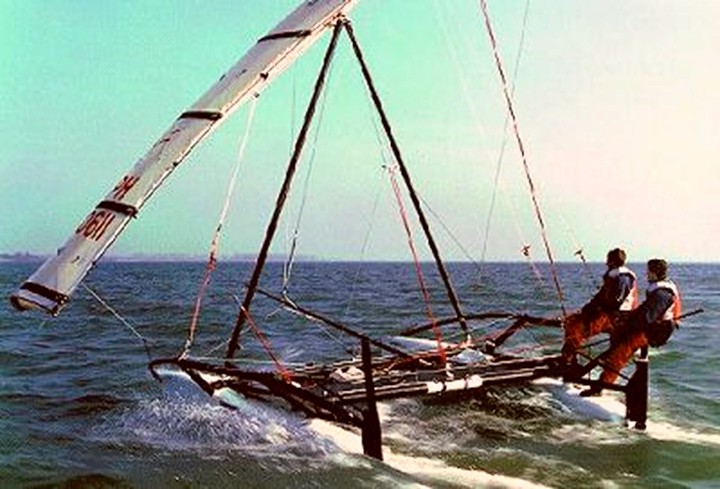
In 1996, FlowMotion was involved in one of its first projects: the development of a high-speed catamaran. The core concept was based on the fact that a ‘standard’ sailing boat is often pushed downwards by wind as it heels, increasing hull resistance in the water. The aim was to design a sail construction tilted in the opposite direction, which would effectively make the boat ‘lighter’ as wind speeds increased. This new concept, featuring an inclined semi-rigid wing, presented significant challenges for both the design engineers and the two sailors (multiple-time European champions).
FlowMotion’s design goal was to develop a wing that not only provided maximum propulsion with minimal drag but also remained aerodynamically stable while sailing. In an optimal scenario, the force vector generated by the wing passes through the catamaran’s centre of gravity, resulting in zero heeling moment. However, as wind direction and speed are rarely constant on the water, the force vector often shifts from this equilibrium. Most wing designs are unstable in this regard: if the boat tilts to one side, the torque increases, causing the boat to heel even faster. During initial test runs, the two sailors experienced this behaviour first-hand.
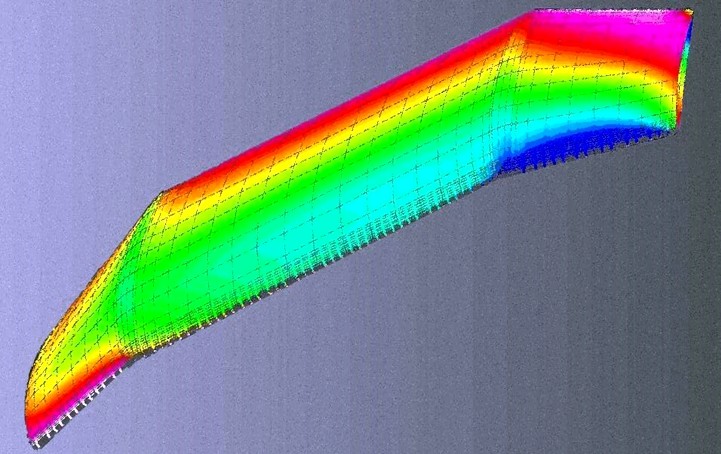
The final wing design was able to largely eliminate this effect. This wing optimisation was conducted using various 2D and 3D computational fluid dynamics (CFD) simulations. A decisive factor in the success of this development was accounting for the wind profile acting upon the wing, as both the strength and direction of the ‘apparent wind’ change depending on the boat’s course and wind speed.
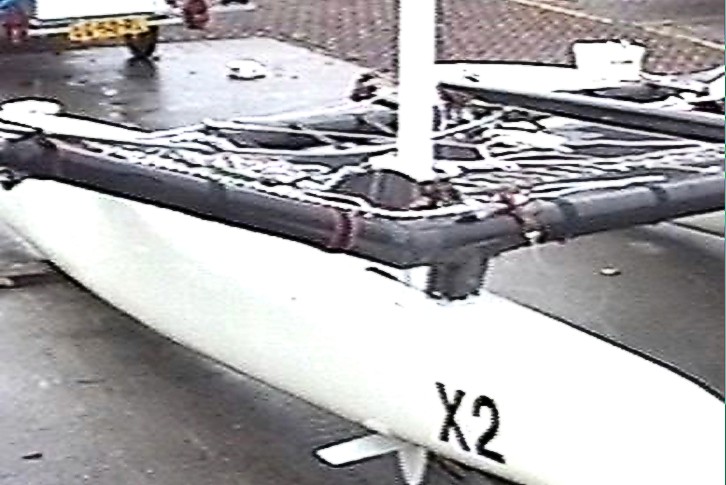
In addition to optimising the wing, the rudder system was improved to reduce water resistance using infrared technology. Through the synergy of diverse engineering disciplines, all rooted in aerospace, a high-speed catamaran was built that took first place at the 1997 Speedweek in Weymouth.