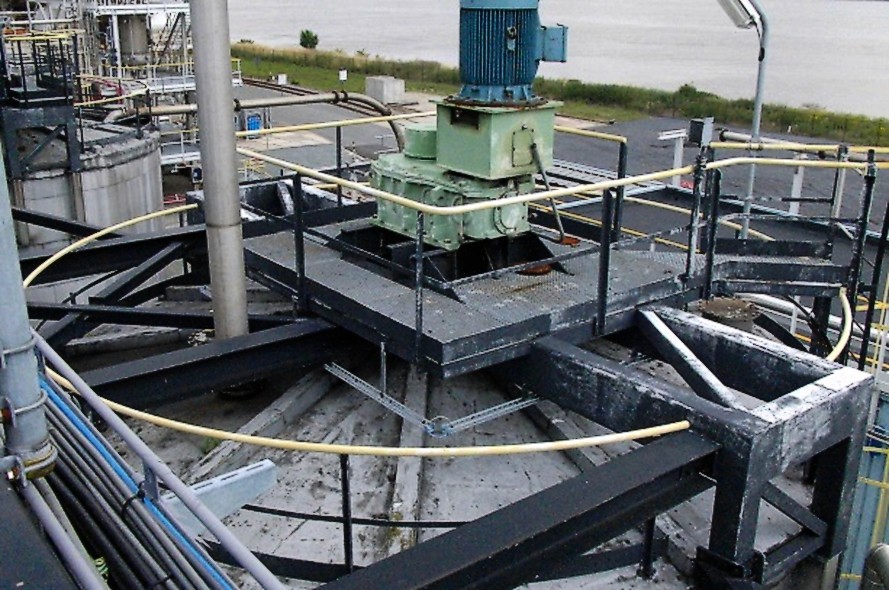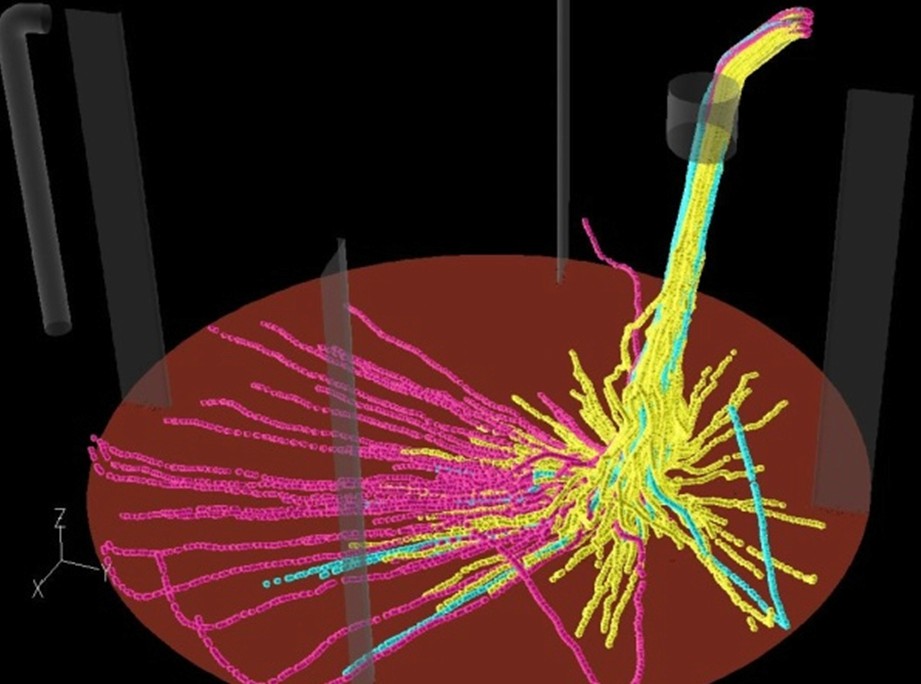
For years, rubber has been separated from air at one of the global production sites in Belgium without any residue escaping into the surrounding environment. In this process, the mixture of film and rubber particles is blown into a large tank and collected in a water reservoir through targeted flow control, where the particles can be specifically skimmed off. As part of a scale-up project, the capacity of the plant is to be doubled. Since different flow conditions were expected in the tank, FlowMotion was commissioned to investigate the flow in the new tank before it was built.
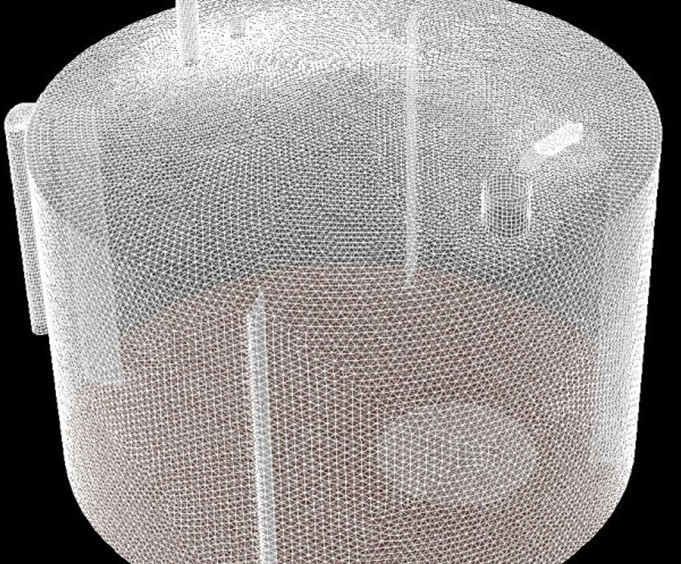
To this end, FlowMotion conducted computational fluid dynamics (CFD) simulations. First, a 3D model had to be created on a computer. Subsequently, the space where the air moves is divided into many small grid cells, known as a computational mesh. To generate the actual flow, the corresponding velocities and pressures are prescribed at the inlets and outlets of the computational domain.
Key challenges during these simulations included modelling the air jet, which is characterised by strong turbulence and shear layers. Secondly, the resistance and gravitational force of the various rubber particles and film bales had to be correctly mapped. Since the particles move through the entire tank, they come into contact with the water surface and the tank walls multiple times in reality. These particle properties at the contact points were also considered in the simulations.
Following validation of the model against the existing design, a multitude of geometric variants were investigated. By defining clear design parameters and analysing the results of all simulations, a specific design could be settled upon, thereby minimising the risks regarding the future plant’s ability to operate as intended.